The Small Business AI Playbook: How to Do the Work of a 25-Person Team By Yourself
Why small businesses have an unfair advantage with AI right now, and the practical playbook to use it.
The Small Business AI Playbook: How to Do the Work of a 25-Person Team By Yourself
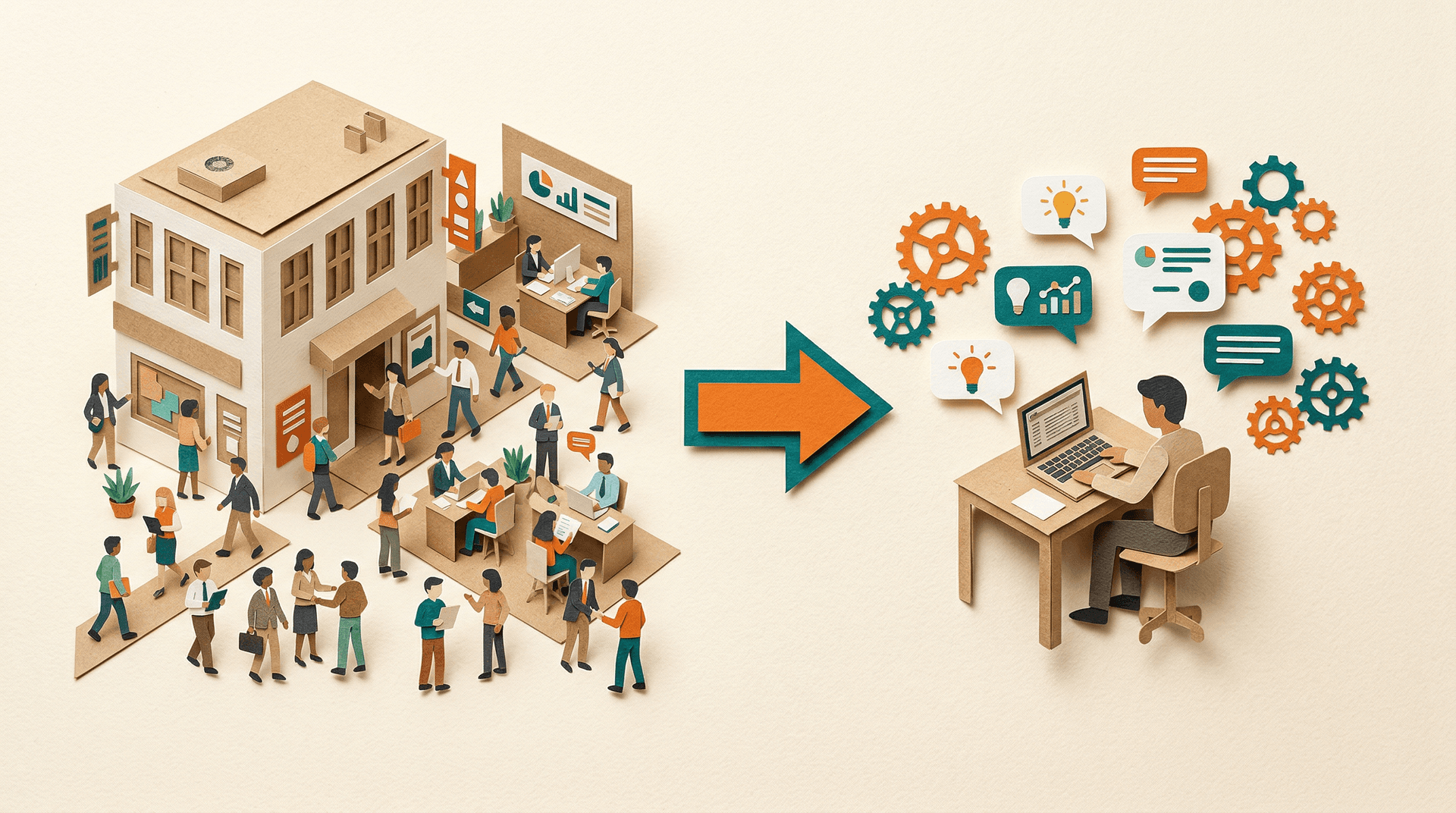
In 2023, I sold my company. 25 people on the team, customers in over a hundred countries, revenue was solid.
One of the reasons I sold it (and I've never shared this publicly) was AI.
Not because AI was going to kill the business. UpViral was profitable, growing, had loyal customers. But I could see where things were heading. ChatGPT had just launched. Most people were debating whether it was a gimmick.
I wasn't debating. I was looking at 25 people, years of legacy code, thousands of customers depending on everything working perfectly, and I thought: if I want to go all in on AI, this is the worst place to start.
The problem with changing an existing business
When you have 25 people working for you (and these weren't just cheap contractors, we had people in the Philippines and India, but also developers and support staff in Germany, the UK, Spain, real salaries), there are hundreds of little processes running every day.
SOPs on top of SOPs. Things just... happen. Support tickets get answered. Features get built. Bugs get fixed. Deployments go out.
And here's the thing most people don't realize: you don't even know all of it. Not really. When you're running a team of that size, the processes run themselves. That's the whole point of building a team, right?
But that also means you can't easily point at something and say "AI should handle that." Because you don't even know half the things that are happening day to day.
Then there's the technical side. UpViral had years of code built up. A large codebase. Thousands of users hitting the servers. You can't just rip things out and experiment. Every change needs testing, staging, careful deployment. The kind of "move fast and break things" mentality that works when you're building something new? Doesn't fly when real businesses depend on your uptime.
And the hardest part? The people.
You can't walk into a room of 25 people and say "hey, half of what you're doing? AI can do that now." I mean, technically you can. But it's slow, expensive, emotionally brutal, and demoralizing for everyone who stays.
So I made a decision. I didn't tell my team. I didn't tell the buyer. But in my head, I knew: if I wanted to go all in on this AI thing (whatever "this" turned out to be), starting from scratch was the smarter bet.
The experiment that proved me right
Fast forward to 2025. I'm building WinningAds, an AI tool that creates Facebook ad variations. New product, clean slate.
Time to hire developers.
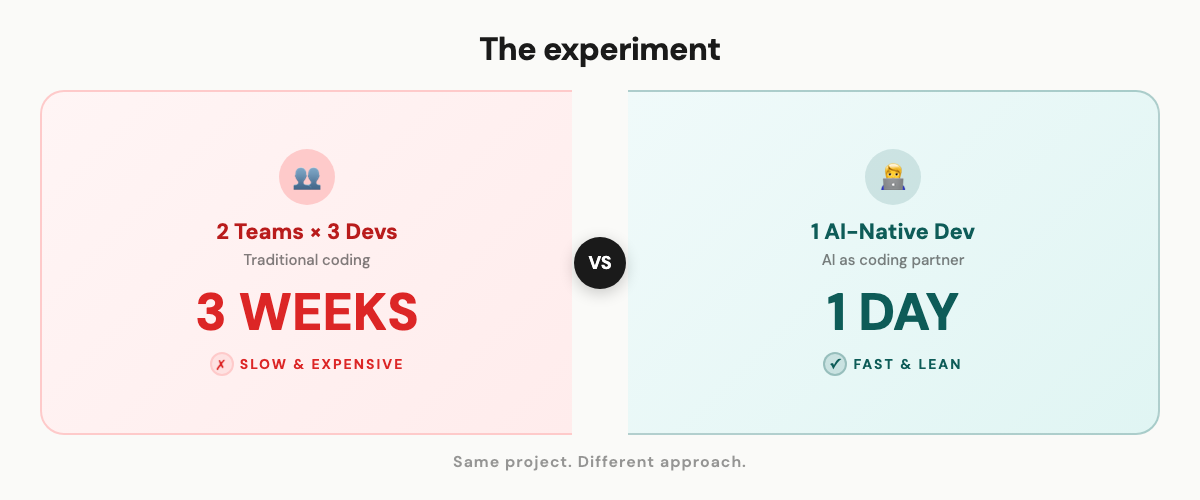
I did something a little unconventional. I hired two separate teams of three developers each. Not to work together. To compete.
I told them both: "For the next three weeks, show me your best work. I'll pick the team that performs best."
Both teams were competent. They used AI here and there, sure. But they weren't all-in on it. They were still writing most of their code the traditional way, line by line, the way developers have been doing it for decades.
Three weeks later, I let all six of them go.
Not because they were bad. Because I found one developer who was fully leaning into AI. Who wasn't just asking AI for help here and there. He was building with it.
On his first day, he showed me more completed work than either team of three had produced in the entire three weeks.
Read that again if you need to.
One person. One day. More output than three people in three weeks.
That's not an improvement. That's a different thing entirely.
The thing nobody talks about
Most people think the AI advantage for small businesses is speed. "You can do things faster now!" Sure. That's true. But it completely misses the real story.
The actual advantage is something I think about constantly. I call it the feedback loop.
Let me show you what I mean.
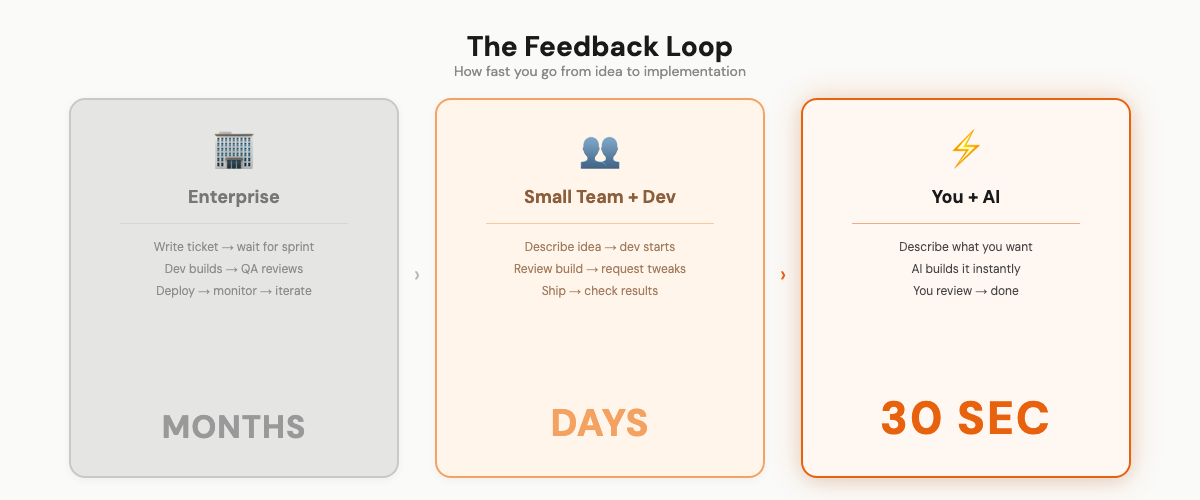
In a big company, the feedback loop is brutal. Someone has an idea. They present it to their manager. The manager brings it to a committee. The committee discusses it, maybe brings in legal or compliance. Eventually it gets approved. Then it's assigned to a team. The team builds it. QA tests it. It gets deployed. Months later, you find out if it actually worked.
MIT found that 95% of enterprise AI projects fail to deliver measurable results. With a feedback loop that long, honestly, how could they not?
When I had a developer (even a great one who was all-in on AI), the loop was shorter but still there. I have an idea. I tell him. He builds it. We test it. Days, sometimes a full week. Way faster than a big company, but I was still waiting.
And that wait is the problem. The person with the idea (me) was never the person implementing it. There was always this gap between "I see what needs to change" and "it's actually changed."
Now? The feedback loop is about 30 seconds.
I'm not exaggerating. If I see something in my marketing process that could be better, I change it myself. I talk to AI, adjust the workflow, and from that moment on, every single piece of output going forward is improved. Not next week. Not after the next sprint. Right now.
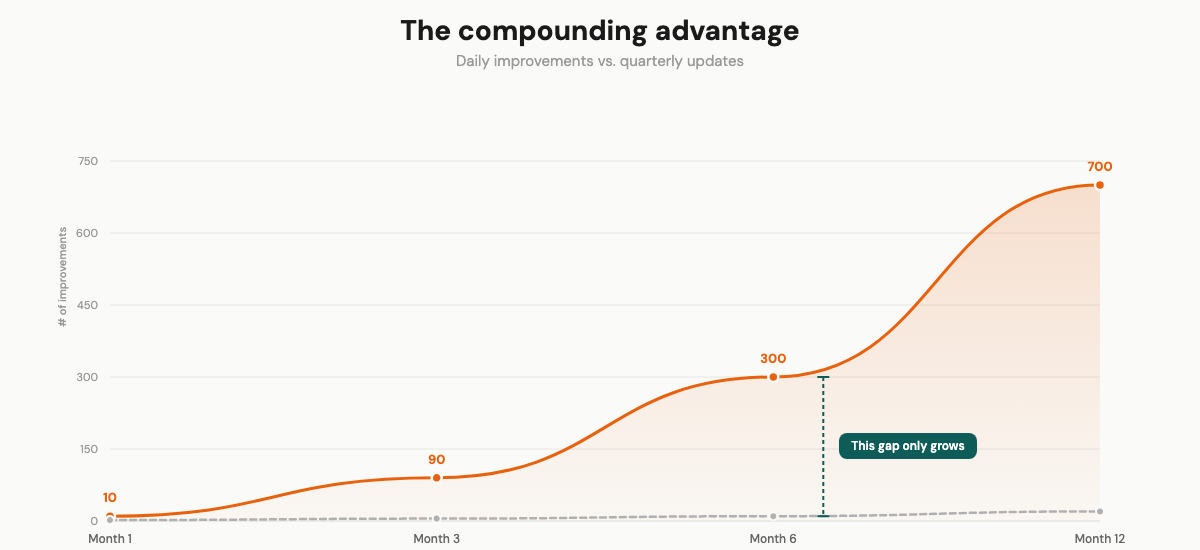
That 30-second feedback loop compounds in a way most people don't appreciate yet. After a month, you've made maybe 40 or 50 small improvements. After six months? Probably a few hundred. Each one small. But stacked together? You've built something that no enterprise competitor can match, because they're still waiting for committee approval on improvement number three.
Why small actually wins right now
I've been on both sides. 25-person team with legacy systems and processes. And now, just me with AI. Here's what I've learned about why small actually wins right now.
You don't need permission
Last month I found a better way to handle my email newsletters. By Tuesday, it was running.
At UpViral? That would've needed a meeting. Maybe two. Someone to evaluate the tool. Security review. Migration plan. Timeline. You know the drill.
When you're small, Monday you find something better, Tuesday you're using it. There's no vendor review committee. No six-month pilot program. You just... do it.
A Slack survey found that 61% of enterprise employees have spent less than 5 hours total learning about AI. Five hours. Some of those companies have "AI strategies" with 40-page decks and dedicated task forces. But the actual people doing the work? Five hours.
Meanwhile, you're using it every day. Breaking things, figuring out what works, getting better at it.
You can actually see what needs to change
This was the big one for me. At 25 people, I genuinely didn't know all the processes running in my own business. Things just happened. Which is great for delegation, terrible for figuring out what AI should handle.
When it's you (or you and maybe one or two people), you see everything. The bottleneck in your invoicing. The report you copy-paste together every Friday. The three-hour process that should take ten minutes.
You already know which customer emails sound the same every week and which part of your workflow makes you want to throw your laptop out the window.
That visibility is worth more than any consultant's "AI transformation roadmap."
You have no legacy to protect
This one's easy to overlook.
When you're starting fresh (or when you're small enough to redesign how you work), you can build your processes around AI from day one. You're not cramming AI into something that already exists. You're starting with it.
Here's what that looks like practically. Let's say you're setting up client onboarding. A bigger company already has an established process. Clients expect a call. The team is trained on the call script. The CRM is configured around it. Changing that? Nightmare.
But if you're building this from scratch? You design the onboarding as a smart questionnaire that feeds directly into your AI system. No call needed. The AI knows everything about the new client before you ever talk to them. Faster for you, honestly better for the client too.
You're not ripping anything out. You're building it right from the start.
One right person beats a big team
I learned this the hard way with those two development teams.
The lesson wasn't "replace people with AI." The lesson was: find people who are already AI-first. One person who actually works with AI every day will outperform a team of five who open ChatGPT once a week.
And here's the small business advantage: you can make that hiring decision in a week. Post the job, interview a few people, pick the one who gets it.
An enterprise? They need to update job descriptions (committee), get budget approval (another committee), go through HR processes (months), onboard the person (weeks). By the time they've hired their first AI-native employee, you've been running with one for half a year.
It compounds while you sleep
I covered the feedback loop earlier, but this is the part that gets me excited.
When you fix a process (not just the output, the actual process), that fix applies to everything going forward. You spot something off at 9am, change it, and by 9:01am every future output is better. Do that daily for six months and you've stacked hundreds of tiny improvements. Your larger competitors? They're still running the same process they approved last quarter.
The practical part: how to actually do this
Okay, so how do you actually do this? Here's what I tell people who ask.
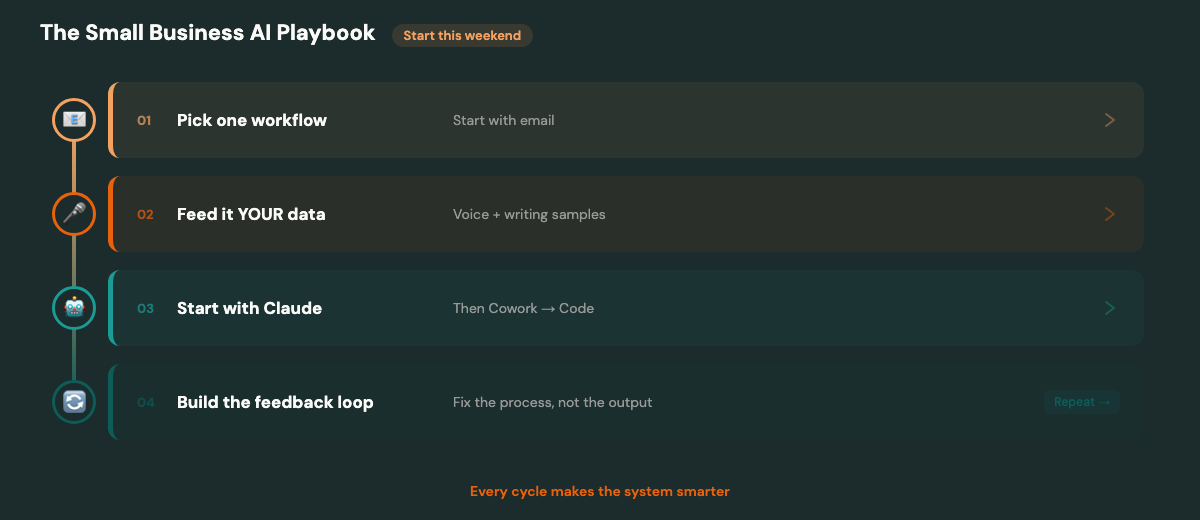
Step 1: Pick one workflow (not everything)
This is the mistake I see constantly. People get excited about AI and try to automate their entire business in a weekend. Then nothing works properly, they get frustrated, and they go back to doing everything manually.
Pick one thing. The most repetitive, time-consuming task that makes you groan every week.
For most people, I'd say start with email. Your newsletter, your customer emails, whatever. It's something you probably already know you should be doing more of, it takes hours every time, and it's the perfect first workflow to hand to AI.
Why email? Because you already know what good sounds like. You can tell in two seconds if the AI nailed it or wrote garbage. Plus, the structure repeats every week, so improvements actually stick. Which brings me to the next step.
Step 2: Feed it YOUR data first
This is where most people go wrong. They fire up ChatGPT or Claude, type "write me an email about X," get something generic and robotic, and conclude that AI doesn't work for their business.
Of course it doesn't work. You gave it nothing to work with.
Before you ask AI to write anything, feed it your voice. Your existing emails. Your website copy. Your social posts. Let it study how you actually sound.
I wrote a whole article about this called "How to Make AI Sound Like You" if you want the detailed process. But the short version is: the more of YOUR writing you give it, the less it sounds like AI and the more it sounds like you. That's the difference between "generic slop that everyone's publishing" and "content that actually sounds human."
Skip this step and you sound like everyone else. Do it right and nobody can copy you.
Step 3: Start with Claude (then grow)
People ask me what tool to use. My answer might surprise you.
Start with Claude. Not a fancy AI marketing platform. Not an all-in-one tool. Just Claude.
Here's why. Most "AI marketing tools" are basically wrappers around the same AI models with a pretty interface and a monthly fee. They add constraints, not capabilities. And they lock you into their workflow instead of letting you build your own.
Claude gives you the raw capability without the guardrails that limit what you can do. Start there. Learn how to have a real conversation with AI. Give it context. Give it your voice. Work with it on your first workflow.
Then, when you're ready for more: try Claude Cowork, which lets AI work alongside you more naturally. And eventually, if you want to build full systems that run on their own, Claude Code.
But don't skip to the end. Start simple. Get one workflow working. Then expand.
Step 4: Build the 30-second feedback loop
Once your first workflow is running, the real trick is making it easy to improve.
Every time you see output that's not quite right, fix the process. Not just the output. The process. So next time, it's automatically better.
If your AI-written email has the wrong tone, don't just edit the email. Go back and adjust the instructions so every future email is better. That's the feedback loop.
Most people edit the output and move on. The ones who win edit the process and compound.
Over time, your system gets genuinely good. It picks up on your voice. It starts catching things it used to miss. Not because the AI got smarter (although it does), but because you kept improving the process, one small tweak at a time.
The mindset that makes it all work
One more thing.
There's a saying in business: ask "who," not "how." When you need something done, don't ask "how do I do this?" Ask "who can do this for me?"
That used to mean hiring people. Now it means AI.
I still catch myself doing it wrong. I'll look at a problem and think "okay, how would I solve this?" Then I stop, give the problem to AI instead, and it figures out something I wouldn't have thought of.
That's the real shift. Stop treating AI as a tool you direct step by step. Treat it like a team member. Give it the goal and the context. Let it figure out the how. You'll be surprised what it comes back with.
This takes practice. Your instinct is to jump in and do things yourself. Fight that instinct. The more you let AI handle, the more you realize it can handle.
The window is open. It won't be forever.
I want to be honest about something. This advantage is real, but it's not permanent.
Enterprises will catch up. They always do. Give them two, maybe three years, and the big companies will have figured out their AI strategies, trained their people, updated their systems.
But right now? Right now, most of them are still stuck. We live in this bubble where it feels like everyone's using AI. But zoom out. Go talk to a "normal" business. Most of them are using ChatGPT occasionally and calling it "AI adoption." That's like saying you're "using the internet" because you have an email address.
The real AI adoption? Building it into how your business actually runs? That's still rare. And if you're small, you can start this weekend.
No compliance review. No training program. Just you and a laptop.
And here's why the timing matters. Every day you spend improving your system is a day your competitors spend debating which AI tool to approve. Six months of that, and you're so far ahead they can't catch up.
I sold a 25-person company three years ago because I saw this coming. Today it's just me and AI. I'm not saying everyone should do what I did.
But if you're small right now? Don't apologize for it. Use it.
Talk soon, Wilco
Get automation ideas delivered to your inbox
Practical AI marketing automations delivered to your inbox. No spam, no fluff — just ideas you can use.