5 Marketing Tasks You're Still Doing By Hand (That AI Handles in Minutes)
Most solopreneurs who try AI for marketing give up within a month. The problem isn't the tools. It's that nobody talks about the real work: getting what's in your head out of your head. Here are five marketing tasks that used to require a team, including the exact extraction process that makes each one possible.
5 Marketing Tasks You're Still Doing By Hand (That AI Handles in Minutes)
My wife spent an entire day building a social media content calendar for a nonprofit. Researching competitors. Organizing 800 photos. Planning posts.
Still wasn't done.
I ran the same task through my system. Five to ten minutes. Full year calendar. All 800 photos categorized, renamed, and matched to posts.
(I probably shouldn't have shown her. She wasn't thrilled.)
I've managed marketing teams of 45 people. Spent more on Facebook ads than most businesses make in revenue. And for the last year, I've been running my entire marketing operation solo.
Not because I had to. Because I wanted to see what was actually possible.
Here's what I found: most solopreneurs who try AI for marketing give up within a month. They open ChatGPT, paste a vague prompt, get something generic back, and think: well, that was useless.
They're right. It was useless.
But not because of the AI.
Someone on Twitter called this "assisted typing." You type a prompt, the AI types back, you copy-paste it somewhere. That's not automation. That's a fancier clipboard.
The actual unlock has nothing to do with prompts or tools. It's getting what's already in your head out of your head.
Every business owner I work with has the same problem. They're domain experts who make dozens of decisions without even thinking about it. They know their audience, their voice, what converts and what doesn't.
But none of that is written down anywhere.
It's all trapped in their skull. And until you extract it, no AI tool on earth can help you.
I spent the last year documenting everything. My voice. My stories. My ad frameworks. My newsletter rules. My lessons from 22 years of building businesses. All turned into something a system can actually use.
Five marketing tasks that used to require a team now happen in minutes. Here are all five, including the exact extraction process that makes each one possible.
I. How I Plan a Full Week of Content in 30 Minutes
Monday morning. Blank page. Trying to figure out what to post this week.
You write something for LinkedIn, then realize Twitter needs something different, and Facebook wants something else entirely.
So you post when you're inspired. And ghost when you're busy.
One good week of content. Three weeks of silence. Repeat forever.
Here's what changed.
I use Claude Code. Not ChatGPT, not a generic AI chatbot. Claude Code is basically an AI that can read, write, and run files on your computer. It can access your documents, execute scripts, browse the web. Think of it as an AI with hands.
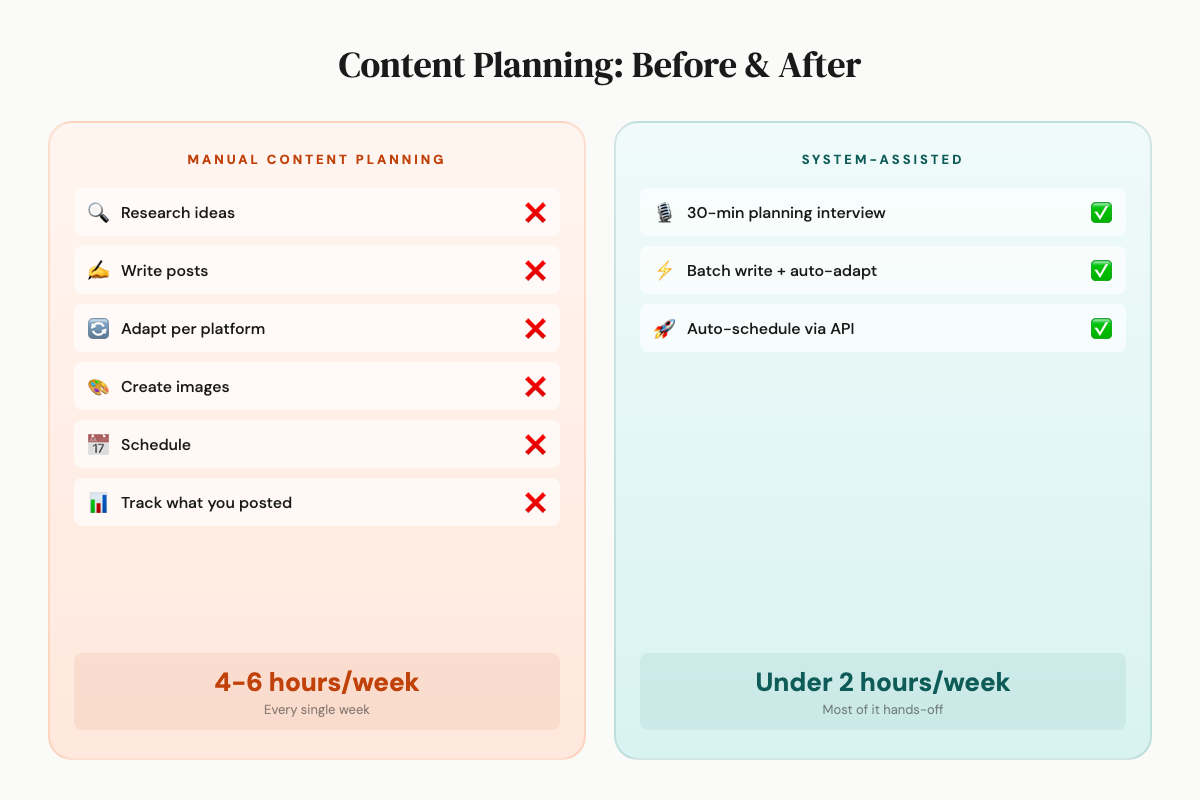
My content planning system scans five sources before I even start: my idea bank, recent trends, past performance, newsletter topics not yet adapted for social, and the content mix (so I'm not posting the same type every day).
Then a quick interview. Three or four questions. What's on my mind? Anything interesting happen?
From that: 14 tweets, 2 LinkedIn posts, 3 Facebook posts, and Instagram carousel flags. Each rewritten for how each platform's algorithm actually works. Not "reposted." Adapted.
30 minutes.
What I had to get out of my head first
But the system doesn't replace your ideas. It replaces the logistics around them. The scheduling, the platform adapting, the "wait, did I already post about this?" tracking.
The raw material still comes from you. And if you haven't documented your stories, your opinions, your unique angle... the AI will give you the same generic content it gives everyone else.
Here's what I extracted to make content planning work:
1. A story bank. I documented 33 personal stories. Each tagged by topic, lesson, and emotional arc. The AI picks relevant stories from this bank when planning content. Without it, it would just generate the same "5 tips for better marketing" posts that everyone else publishes.
2. A tone-of-voice document. Not "write in a friendly tone." That's useless. I documented specific patterns: I use parentheticals when being self-deprecating. I sign off emails with "Talk soon." I never use em dashes (those are an AI writing tell, by the way). I prefer allegories for complex concepts. With these patterns documented, the AI stops sounding like a press release and starts sounding like me.
3. Platform-specific rules. Twitter gets punchy fragments. LinkedIn gets professional depth. Facebook gets casual storytelling. These aren't preferences. They're how each algorithm actually distributes content. I wrote down the differences once. Now every post is automatically adapted.
That's the extraction work. And it's the part most people skip.
II. 50 Ad Variations in One Session (After Spending $10M+ to Learn What Works)
I've personally spent over ten million on Facebook ads. My own money. My own businesses.
Here's the typical solopreneur workflow: spend 30 minutes on one ad. Pick a stock photo. Write copy. Upload. Hope it works.
The problem? Meta's algorithm needs 8 to 12 genuinely different creative angles to find winners. Most solopreneurs run 2 or 3 variations and wonder why nothing scales.
Years ago, Facebook invited me for an account review call. The rep asked: "How long do people watch your video ads on average?"
I had no idea.
Five seconds.
That changed everything. I stopped creating multiple complete videos. Instead: one video, multiple different intros. Just the first 3 to 10 seconds changed between variations.
And because five seconds was all I had, I started doing ridiculous things. Card tricks. Explosions. At one point I was dancing around my office in a full bear costume because our tests showed it outperformed every "professional" intro we'd tried.
The things you do when the data tells you to.
That's what AI is actually good at. Testing lots of variations, fast, without burning through a creative team's patience.
My system generates 50 ad variations in a single session. Not 50 versions of the same idea. Fifty different angles, each with a matching visual, copy checked against Meta's policies, and a format designed to blend into the feed.
$10M worth of lessons, now documented
All those expensive lessons from $10M in ad spend? They're now documented rules that the AI follows automatically.
1. The "Feed Blend Test." Every ad concept gets checked against four questions: Would this stop YOUR scroll? Does it look like something a friend would post? Can you tell it's an ad within the first half-second? Would you screenshot this and send it to someone? If it looks like an ad, kill it. Native-looking content gets roughly 4x higher click-through rates, 50% lower costs than polished brand creative. That's what I've seen across millions in spend.
2. Ad copy frameworks. Not just "write compelling copy." I documented 12 specific angles that have worked across different offers, price points, and audiences. Pain-agitate-solve for cold traffic. Before-after-bridge for warm. Social proof leads for retargeting. Each framework includes examples from ads that actually converted. Claude Code picks the right framework based on the campaign objective.
3. Compliance rules. Meta rejects ads for things you wouldn't expect. "Are you struggling with..." implies a personal attribute (banned). Income claims need disclaimers. Before/after comparisons have specific rules. I documented every rejection I've ever gotten and the fix that worked. The system now catches these before I waste time uploading.
@codyschneiderxx runs 7 different AI agents for marketing, including bulk ad creation. @emilykramer calls this the "Gen Marketer" era. I think they're both onto something real.
Fair warning though: the AI generates fast, but it doesn't know your audience, your offer, or which angles already tanked. That context comes from you.
Automate the wrong things and you'll just burn money faster.
Ask me how I know.
III. AI-Edited Video (The Experiment That Blew My Mind)
This one surprised me most.
Everyone talks about AI for writing. For images. Almost nobody talks about AI for video editing. But for solopreneurs, editing is the most expensive marketing task. Not in money. In time.
A proper YouTube video takes 4 to 8 hours of editing. Freelancer? $200 to $500 per video. Weekly? You're looking at $1,500 to $3,000 a month just for editing.
Most solopreneurs either skip video entirely or publish raw recordings.
How it started
I had some video ads I'd just recorded. Normally I'd send them to my team to edit, but I wanted them live faster. So I just told Claude Code: remove the silences, cut the mistakes, add some animations and B-roll.
I had to give it some feedback here and there. But within a short time, those videos were edited. Done.
Then I thought: what if I save this as a reusable skill? So every time I have raw footage, I just point Claude Code at the folder and it handles the edit.
That's when it clicked. Not the first edit. The moment I realized this could be repeatable.
The YouTube experiment
To test the skill properly, I went outside and shot a quick video. One main recording, one B-roll clip. Made some deliberate mistakes in it to see if the system would catch them.
I asked Claude Code to do the full edit.
Not "write me a prompt." Actual editing. Silence detection, crop classification based on what I'm saying (tight crop for key moments, normal for regular delivery), color correction, a 7-step audio mastering chain, and programmatic B-roll animations built in Remotion (a React-based framework that generates video from code).
It figured it out.
Here's a 2-minute video showing what it looks like:
The audio chain alone: highpass filter, lowpass, presence EQ, warmth, de-esser, compressor, loudness normalization. Used to be separate decisions a sound engineer would make. Now codified.
The preference I didn't know I had
This is where I learned something unexpected about extraction.
I didn't realize that the edit needed zoom-in and zoom-out variations until I watched the first version back. It was technically correct. Silences removed, mistakes cut, audio cleaned up. But it was boring. Just one static frame the entire time.
So I documented my editing preferences:
1. Cut frequency. Every 5 to 7 seconds, something should change. A zoom, a crop switch, a B-roll clip. Without this rule, the AI just delivered a clean but static video.
2. Crop rules. Normal framing for regular information delivery. Punched-in (closer crop) for emphasis. Tight crop for revelations or emotional moments. I told the system when to use which based on what I'm actually saying.
3. B-roll ratio. 5 to 10% of the video runtime should be B-roll or animations. Not more (distracting), not less (boring). The system generates these automatically using Remotion, matching the visual to what I'm talking about.
4. Maximum silence. 0.6 seconds. Anything longer gets trimmed to a natural-feeling pause. This alone made the biggest difference. Raw footage feels slow because of dead air. Remove it, and the energy completely changes.
I'll be straight: AI editing isn't as polished as a great human editor. Not yet.
But the jump from "no editing" to "AI editing" is massive. And it keeps getting better as I feed the system more examples of what I actually want. Hours reduced to minutes, especially once the animations are factored in. That's kind of insane.
IV. Newsletters That Sound Like Me (Not Like a Robot Wrote Them)
A quote from Reddit that stuck with me:
> "The biggest leak was just... not following up. Abandoned carts, leads that filled out a form and heard nothing for 3 days. Embarrassing but real."
Newsletters are the business equivalent. Everyone knows they should write one. Most start strong. By week 6, the cadence breaks. By week 12, the list goes cold.
Writing a good newsletter: research, write, edit, deliverability check, format, schedule. That's 2 to 4 hours minimum. Some people spend a full day.
And here's the cruel part: skip a few weeks and then send something that sounds like AI wrote it? You're worse off than staying quiet. Your newsletter lands in someone's inbox. The most personal digital space they have. If it sounds fake, they notice.
Why "write in a friendly tone" is worthless
The newsletter skill loads the last 5 emails I actually sent before writing anything new. Not as "style reference." As raw material. 28 real emails I've written over the years, indexed and searchable.
But here's the part that took me months to get right. Telling AI to "write in a friendly tone" is worthless. Every AI writes in a "friendly tone." That's the default. To actually sound like a specific person, you need to document the weird, specific patterns that make your writing yours.
1. The voice document. I documented 15+ patterns from my own writing. I use parentheticals when I'm being self-deprecating. I sign off with "Talk soon." I never use em dashes (AI writing tell). I like allegories for complex concepts. I use short paragraphs, one idea each. These patterns are oddly specific, and that's the point. Generic instructions produce generic writing.
2. The humanizer checklist. After every draft, the system runs 15 checks against common AI writing patterns. The "rule of three" (AI loves grouping things in threes). Negative parallelisms ("It's not just X, it's Y"). Words nobody uses in conversation: "crucial," "moreover," "comprehensive." Elegant synonym cycling where the AI uses five different words for the same thing to avoid repetition. If any check fails, it rewrites that section.
3. Deliverability rules. I documented 6 checks that run before any email can be called "done." Spam trigger words ("free," "guarantee," "act now" in certain contexts). Link-to-text ratio. Image-to-text balance. Preview text (impacts open rates 8 to 20%). Subject line length. These used to be things I'd forget to check. Now they're automatic.
4. Continuity tracking. The system knows what I've published before. A recent newsletter referenced a tweet that went viral (114K views on 4K followers). The system suggested the callback because it had context about what I'd published. I didn't have to remember. The system remembered.
Idea to published draft: under an hour.
This only works because I invested time upfront. Not with a prompt. Not with "write in a friendly tone." With 28 actual emails. That effort happened once. Now every newsletter benefits.
V. A Complete Landing Page in 30 Minutes (Here's What That Actually Means)
I recently created a complete sales page. Start to finish: 30 minutes.
I know. Clickbait energy.
But a proper landing page isn't "write sales copy." It's competitor research, headline testing, positioning, visual direction, friction audit, compliance check, and A/B test plan.
Most businesses pay $3,000 to $10,000 for a copywriter plus designer. Wait 2 to 4 weeks. Or rush something that converts poorly.
What "30 minutes" actually included: positioning analysis, 3 competitor pages analyzed, audience research from documented personas, 9 headline types scored on 5 criteria, copy across 13 sections, visual direction, friction audit, compliance check.
Most of that was me waiting.
What the system knows before it writes a word
1. Buyer personas. Not "Sarah, 35, likes yoga." Real documents. I have four detailed personas, each with specific pain points, objections they raise on sales calls, exact phrases they use to describe their problems, and their awareness level (do they know the solution exists, or just that they have a problem?). When the system writes landing page copy, it writes to a specific person with specific concerns. Not to "target audience."
2. Objection handling. Every sales call surfaces the same 5 to 8 objections. I wrote them all down, along with the responses that actually work. The landing page system weaves these into the copy naturally. The FAQ section isn't generated from imagination. It's built from real conversations.
3. The friction audit framework. The system simulates two reader types: a cynical consumer scrolling at 11pm (looking for reasons NOT to buy) and a careful evaluator comparing options. It checks four friction categories: cognitive (too confusing?), emotional (too pushy?), visual (too cluttered?), and trust (enough proof?). That catches things I'd miss. Before the page goes live. Not after I've wasted ad budget on a broken funnel.
The trick isn't speed. It's iteration speed. A world-class copywriter's 3-week version probably outperforms my 30-minute version. Probably.
But I can run 10 iterations in the time they get one round of feedback.
Build. Test. Learn. Rebuild. Single afternoon.
@gregisenberg calls this the "vibe marketing" era. What used to need a strategist, a copywriter, and a designer... one person, one afternoon. Not because AI is smarter than three people combined. Because it's faster at the 80% that doesn't require human creativity.
The 30-minute version won't win awards. But "good enough to launch" beats "perfect but stuck in your head" every time.
You can improve a live page. You can't improve one that doesn't exist.
---
The Part Nobody Talks About
Every business owner I've helped set up AI marketing has the same moment.
It's never when the AI writes their first newsletter.
It's when they realize how much they know that they've never written down.
One runs a wellness brand. Five separate AI tools. ChatGPT for copy. Claude for strategy. Gemini for research. A custom GPT for brand voice. Another for her content calendar. Each knew a fragment. None knew the whole thing. Half her week spent re-explaining context.
Another does high-end copywriting. Charges thousands per sales page. Spending two hours per page despite "using AI." Because she was chatting, not building. Every conversation started from zero.
The fix wasn't a better tool. It was extraction.
How to start extracting (even if you never use my system)
Here's the honest version of what extraction looks like. You don't need Claude Code for this. You don't need any specific tool. You need a document and 30 minutes of honesty.
Start with these five questions:
- How do you actually sell? Not your elevator pitch. The real thing you say on a sales call when someone's on the fence. The exact words that make people go "oh, I get it now."
- What are the top 5 objections you hear? Write them in the customer's exact words. Not your interpretation. Their words. And write down what you say back.
- What stories do you tell at dinner parties about your business? These are your best content. They're already refined through dozens of tellings. They have punchlines. They have emotional hooks. Write them down.
- What do your customers say about you that surprises you? The specific phrases they use. Not "great service." The weird, specific thing, like "you made me feel like I wasn't crazy for wanting this." That language is marketing gold.
- What do you know that you can't explain? The intuitive decisions you make without thinking. "I just know when an ad isn't going to work." Cool. What specifically tells you that? Sit with it. Write it down. These are the highest-value extractions.
Here's the paradox: this extraction makes your business better even if you never touch AI again. Once you've documented your voice, your process, your decisions, you've created something that compounds. Hires can reference it. Collaborators can use it. AI can run with it.
Getting what's in your head out of your head? That's the expensive part. Not in money. In honesty about what you actually do and why.
---
These five tasks used to require a team. Or an agency. Or just not sleeping.
Now they require something different: the willingness to sit down, look at how you actually work, and turn it into something a system can learn from.
The AI is the easy part. You're the hard part.
And honestly? That's good news. Because the people who do this work will have an advantage that can't be copied by someone who just downloaded the same tool.
Talk soon,
Wilco
Get automation ideas delivered to your inbox
Practical AI marketing automations delivered to your inbox. No spam, no fluff — just ideas you can use.